
Official Honey Pezil Supplement Facts: Label Transcript, Milligrams and Testing
The complete panel from the maker's label artwork, typed out line by line, with each salt form converted into the amino acid it delivers and a plain account of what testing has, and has not, been published.
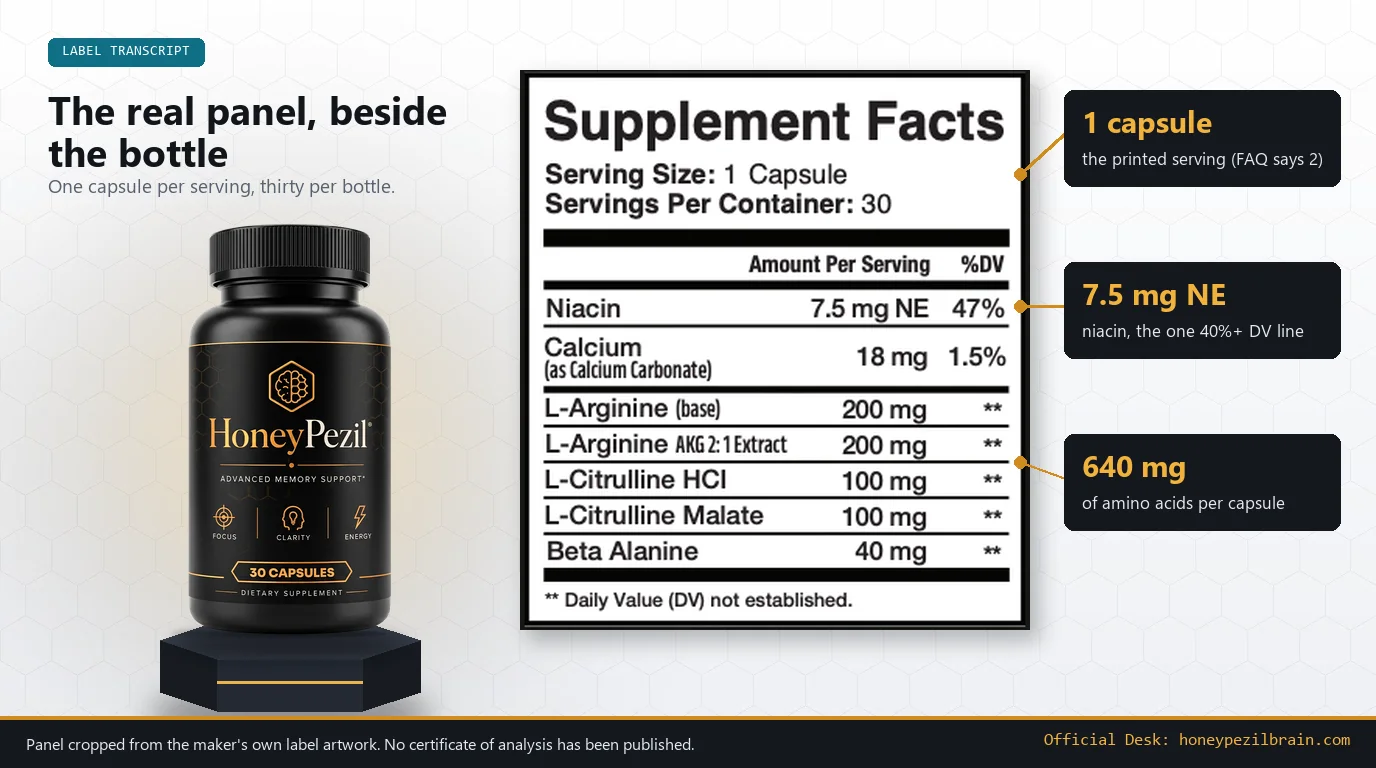
The full Honey Pezil Supplement Facts panel
Below is the HoneyPezil Supplement Facts panel exactly as it appears on the maker's label artwork, published on the brand's website in June 2026, followed by a typed transcript. Nothing has been added, rounded or reordered.
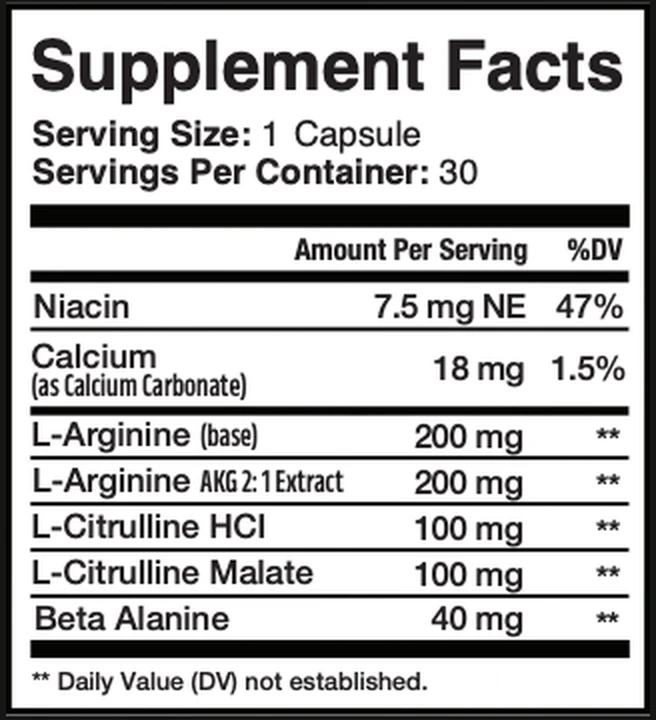
| Supplement Facts · Serving size 1 capsule · 30 servings per container | Amount per serving | %DV |
|---|---|---|
| Niacin | 7.5 mg NE | 47% |
| Calcium (as Calcium Carbonate) | 18 mg | 1.5% |
| L-Arginine (base) | 200 mg | ** |
| L-Arginine AKG 2:1 Extract | 200 mg | ** |
| L-Citrulline HCl | 100 mg | ** |
| L-Citrulline Malate | 100 mg | ** |
| Beta Alanine | 40 mg | ** |
Footnote on the panel: ** Daily Value (DV) not established.
Other ingredients: Hypromellose (Vegetable Capsule), Vegetable Stearate, Silicon Dioxide.
Front of bottle: HoneyPezil®, Advanced Memory Support*, Focus · Clarity · Energy, 30 Capsules, Dietary Supplement.
Line by line: what each entry on the panel means
Reading a Supplement Facts panel well means knowing what each line can and cannot tell you. Here is the panel decoded from top to bottom.
Serving size: 1 capsule
Every amount below refers to one capsule. The bottle holds 30, which is the basis for the seller's "30-day supply" per bottle. This line matters because the maker's homepage FAQ tells buyers to take two capsules a day. A label is the document the FDA holds a seller to[1]; at two a day, a bottle would last 15 days and every price-per-day figure would double.
Niacin, 7.5 mg NE, 47%
The only line with a meaningful percentage. NE stands for niacin equivalents. The Daily Value for niacin is 16 mg NE[3], so 7.5 mg works out to 46.9%, rounded to 47%. The form, nicotinic acid or niacinamide, is not stated.
Calcium (as calcium carbonate), 18 mg, 1.5%
A small mineral line. Against the 1,300 mg Daily Value, 18 mg is about 1.4%, which the label rounds to 1.5%. Calcium carbonate is a common capsule-filling aid; its presence on the panel is a labeling requirement, not a marketing claim.
The five amino acid lines with **
L-Arginine (base) 200 mg, L-Arginine AKG 2:1 Extract 200 mg, L-Citrulline HCl 100 mg, L-Citrulline Malate 100 mg and Beta Alanine 40 mg. The double asterisk means no Daily Value exists for these, which is normal: the FDA sets DVs for vitamins, minerals and macronutrients, not for individual amino acids. Each line still states its weight per capsule, so nothing is hidden.
Totals
Declared ingredients add up to 665.5 mg per capsule, 640 mg of which are amino acid salts. That fills most of a large capsule, which is the physical reason the amounts cannot be much higher.
Salt forms converted to free amino acids
Research papers report doses of free amino acids, but labels often list salts, which are heavier. Converting is simple arithmetic using molecular weights, and it changes the picture.
| Label line | Salt weight | Share that is the amino acid | Free amino acid |
|---|---|---|---|
| L-Arginine (base) | 200 mg | 100% (no salt) | 200 mg arginine |
| L-Arginine AKG 2:1 | 200 mg | 2 x 174.2 / (2 x 174.2 + 146.1) = 70.5% | about 141 mg arginine |
| L-Citrulline HCl | 100 mg | 175.2 / (175.2 + 36.5) = 82.8% | about 83 mg citrulline |
| L-Citrulline Malate | 100 mg | 72.3% at 2:1, 56.6% at 1:1 (ratio not printed) | 57-72 mg citrulline |
| Beta Alanine | 40 mg | 100% | 40 mg |
So one capsule delivers about 341 mg of arginine and about 140 to 155 mg of citrulline. For comparison, the AAKG study in trained men used 12 g of the salt per day[6], the citrulline pharmacokinetic study 1.5 to 6 g of citrulline per day[5], and the beta-alanine position stand 4 to 6 g per day[7]. Remember too that arginine is heavily metabolized before it reaches the blood[4]. A full comparison is on the ingredients page.
Other ingredients: the capsule and processing aids
The "Other Ingredients" line lists three components, each common in capsule supplements.
- Hypromellose (vegetable capsule). Hydroxypropyl methylcellulose, a plant-derived cellulose that forms the capsule shell. It replaces gelatin, so the product contains no animal-derived capsule material.
- Vegetable stearate. A lubricant, typically magnesium stearate made from vegetable oil, used in small amounts so powder flows through filling machines.
- Silicon dioxide. An anti-caking agent that keeps fine powders from clumping.
Not listed: sugar, sweeteners, colors, flavors, preservatives, stimulants, herbs. No allergen statement appears. The product is not marketed as certified vegan, gluten-free or non-GMO on the label itself, although the homepage displays non-GMO and GMP badges without naming a certifier.
Directions, storage and the caution box
The label's left panel carries the directions and cautions, transcribed here:
Suggested use: As a dietary supplement, take one (1) capsule daily with an 8 oz. glass of water. For best results, take 20-30 minutes before a meal with 8 oz of water or as directed by your healthcare professional.
Storage: Store in a cool, dry place away from heat and light.
Caution: Do not exceed recommended dose. Pregnant or nursing mothers, children under the age of 18 and individuals with a known medical condition should consult a physician before using this or any dietary supplement. Keep out of reach of children. Do not use if safety seal is damaged or missing.
Three practical points follow. The before-meal timing is a convention rather than a requirement, since amino acids compete with dietary protein for absorption; taking it before food may help slightly. The caution box is broad by design: "a known medical condition" covers high or low blood pressure, heart disease, kidney disease and anyone taking prescription drugs, all reasons to check with a doctor. And the seal instruction is worth following literally; a broken seal on arrival is grounds to contact the seller before opening.
The label versus the homepage
| Topic | Printed label | Maker's homepage |
|---|---|---|
| Daily dose | 1 capsule | 2 capsules per day |
| Ingredients | 7 entries listed above | FAQ adds B6, vitamins C and E, DMAE, bacopa |
| Supply per bottle | 30 servings | "60 Day Supply" for 2 bottles (matches 1 a day) |
| Origin | Made in USA, globally sourced ingredients | FDA-registered facility (unnamed) |
Who makes it: the distributor block and origin claims
The label's distributor block reads: Distributed by Gex Corporation LLP, PO Box 12730, Ogden, UT 84404, +1 (507) 448-8190, [email protected]. "Distributed by" means Gex Corporation LLP markets the product; it does not mean it manufactures it. The actual manufacturer is not named on the label or the website, which is legal but limits what a buyer can verify.
The label also says "Manufactured in the USA with globally sourced ingredients". That is a common and honest formula: amino acids such as arginine and citrulline are largely produced by fermentation overseas and then blended and encapsulated domestically. The homepage adds that the facility is FDA-registered. Registration means the plant has listed itself with the FDA; it is not an approval or certification, and the FDA does not approve dietary supplements[1]. All supplement manufacturers must follow the current good manufacturing practice rules in 21 CFR Part 111[2].
Lab testing: what a certificate of analysis would show
A certificate of analysis (CoA) is a lab report for one production lot. For a product like this, a full CoA would typically show: the measured amount of each declared ingredient as a percentage of the label claim; identity tests confirming each ingredient is what it says; heavy metals (lead, arsenic, cadmium, mercury), often against limits such as those in USP chapter 2232 for elemental contaminants in supplements; microbial counts and pathogen tests; and the lot number, manufacture date and expiry.
The maker has not published a CoA for any HoneyPezil lot, and we have not seen one. We therefore print no test results, purity percentages or lab names; any site that shows them without a link to the actual certificate is inventing them. If testing matters to you, email [email protected] with the lot number printed on your bottle and ask for that lot's certificate of analysis. A company that tests properly can usually send one. If no CoA arrives before your refund deadline, that is a reasonable factor in deciding whether to keep the product.
NCCIH's advice on using supplements wisely makes the broader point: products can contain more, less or other than what the label says, and third-party seals from organizations such as USP or NSF are the clearest outside check[9]. HoneyPezil carries no such seal.
About the testimonials on the label page. The maker's page pairs the panel with five-star quotes. Federal guides require endorsements to reflect typical results or clearly disclose that they do not[8]; the seller's footer does state that results are not typical.
Questions readers ask about this
How many capsules of Honey Pezil should I take a day?
One. The label states a serving size of one capsule and suggested use of one capsule daily with 8 oz of water. The maker's homepage FAQ says two, but the label is the authoritative document.
How many servings are in a bottle of Honey Pezil?
Thirty. At the labeled one capsule a day, a bottle lasts 30 days; two bottles 60 days, three 90 days and six 180 days.
Does Honey Pezil have a proprietary blend?
No. Each of the seven ingredients has its own printed amount, from 7.5 mg of niacin to 200 mg each of two arginine forms.
What does NE mean next to niacin?
Niacin equivalents, a unit that counts niacin plus the niacin the body can make from tryptophan. The Daily Value is 16 mg NE, so 7.5 mg NE is 47%.
Is there a lot number or expiry date on Honey Pezil?
Supplement bottles normally carry a lot code and a best-by date, usually on the bottom or the label edge. The label artwork published online does not show them, so check your bottle and record the lot with your order number.
Has Honey Pezil been third-party tested?
Not publicly. No certificate of analysis or third-party seal such as USP or NSF has been published. You can request your lot's CoA from [email protected].
Sources behind this page
Each link opens the original abstract or agency page. The trials gave single ingredients, usually in grams rather than milligrams; no study has tested the HoneyPezil capsule itself.
- 1U.S. Food and Drug Administration. Questions and Answers on Dietary Supplements. www.fda.gov/food/information-consumers-using-dietary-supplements/questions-and-answers-dietary-supplements
- 2Electronic Code of Federal Regulations. 21 CFR Part 111: Current Good Manufacturing Practice in Manufacturing, Packaging, Labeling, or Holding Operations for Dietary Supplements. www.ecfr.gov/current/title-21/chapter-I/subchapter-B/part-111
- 3NIH Office of Dietary Supplements. Niacin: Fact Sheet for Health Professionals. ods.od.nih.gov/factsheets/Niacin-HealthProfessional/
- 4Wu G, Morris SM Jr. Arginine metabolism: nitric oxide and beyond. Biochem J. 1998;336(Pt 1):1-17. pubmed.ncbi.nlm.nih.gov/9806879/
- 5Schwedhelm E, Maas R, Freese R, et al. Pharmacokinetic and pharmacodynamic properties of oral L-citrulline and L-arginine: impact on nitric oxide metabolism. Br J Clin Pharmacol. 2008;65(1):51-59. pubmed.ncbi.nlm.nih.gov/17662090/
- 6Campbell B, Roberts M, Kerksick C, et al. Pharmacokinetics, safety, and effects on exercise performance of L-arginine alpha-ketoglutarate in trained adult men. Nutrition. 2006;22(9):872-881. pubmed.ncbi.nlm.nih.gov/16928472/
- 7Trexler ET, Smith-Ryan AE, Stout JR, et al. International Society of Sports Nutrition position stand: beta-alanine. J Int Soc Sports Nutr. 2015;12:30. pubmed.ncbi.nlm.nih.gov/26175657/
- 8Electronic Code of Federal Regulations. 16 CFR Part 255: Guides Concerning the Use of Endorsements and Testimonials in Advertising. www.ecfr.gov/current/title-16/chapter-I/subchapter-B/part-255
- 9National Center for Complementary and Integrative Health. Using Dietary Supplements Wisely. www.nccih.nih.gov/health/using-dietary-supplements-wisely
Run a fair 60-day test of Honey Pezil
Payment happens on the seller's BuyGoods checkout. Take one capsule a day exactly as the label says, write down two or three memory moments you want to see change, and if nothing has shifted by about day 50, email the seller while the refund window is still open.