
Honey Pezil Ingredients: Every Declared Milligram, Salt Form and Study
Seven ingredients, every one with a printed amount. This page converts each salt form into the amino acid it delivers and sets it beside the doses human studies actually used.
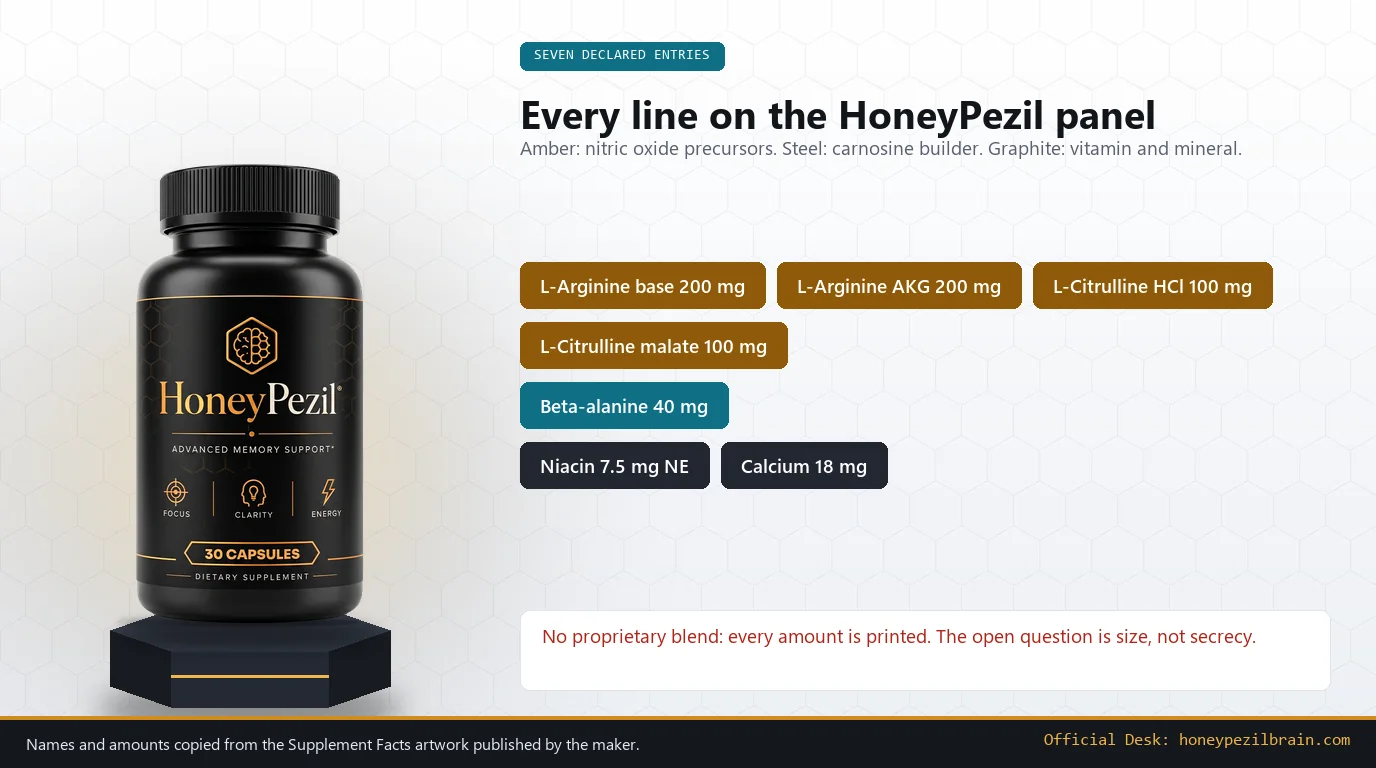
The seven declared Honey Pezil ingredients at a glance
The HoneyPezil label lists seven ingredients, and unlike most memory supplements it prints an amount for every one of them. That makes this page unusually concrete: instead of guessing what a proprietary blend might contain, we can set each milligram figure beside the doses used in published human research. The table converts the salt forms (AKG, HCl, malate) into the free amino acid they actually deliver, because that is the figure research papers report.
| Label line | Printed amount | Free amino acid (est.) | Typical study dose | One capsule covers |
|---|---|---|---|---|
| L-Arginine (base) | 200 mg | 200 mg | 3-9 g/day (vascular) | see total |
| L-Arginine AKG 2:1 | 200 mg | about 141 mg | 12 g AAKG/day (sport) | 1.7% of AAKG dose |
| Arginine, total | 400 mg | about 341 mg | 3 g/day low end | about 11% |
| L-Citrulline HCl | 100 mg | about 83 mg | 1.5-6 g/day | see total |
| L-Citrulline Malate | 100 mg | 57-72 mg | 6-8 g/day (sport) | see total |
| Citrulline, total | 200 mg | about 140-155 mg | 3 g/day | about 5% |
| Beta-Alanine | 40 mg | 40 mg | 2.4-6.4 g/day | 1.7% or less |
| Niacin | 7.5 mg NE | n/a | RDA 14-16 mg NE | 47% DV |
| Calcium (carbonate) | 18 mg | n/a | RDA 1,000-1,200 mg | 1.5% DV |
Two features stand out. First, the formula is honest about what it contains: there is no blend hiding a token sprinkle of an expensive extract. Second, the honesty exposes the size problem. Every amino acid sits well below the lowest dose that has shown a measurable effect in people, and the only ingredient near a nutritional dose, niacin, is one most American adults already get enough of from food. The sections below take each ingredient in turn: what it is, what the maker says about it, and what the studies actually measured.
L-Arginine (base): the nitric oxide substrate
200 mg per capsule
L-arginine is a conditionally essential amino acid: healthy adults make enough of it, but needs can rise during illness or rapid growth. It sits at a busy junction of metabolism. It is the substrate for nitric oxide synthase, but it is also used to make urea, creatine, agmatine, polyamines and proline, and the enzyme arginase competes for it constantly[1]. That competition matters for anyone swallowing it. Arginase in the gut wall and liver breaks down a large share of an oral dose before it reaches the general circulation. A Stanford pharmacokinetic study gave volunteers 10 g by mouth and found an absolute bioavailability of roughly 20%[2].
What the maker claims
The homepage says the body converts arginine "directly into nitric oxide", widening brain blood vessels so more oxygen and nutrients reach neurons, which it links to fewer blanks when recalling names or where you left your keys. The first half of that chain is textbook biochemistry. The second half, from a 200 mg dose to better recall, has never been demonstrated.
What the research measured
The strongest human evidence concerns blood pressure. A 2011 meta-analysis pooled 11 randomized, double-blind trials with 387 participants taking 4 to 24 g a day and found average drops of 5.4 mmHg systolic and 2.7 mmHg diastolic[4]. Reviews of arginine's pharmacology describe an "arginine paradox": because nitric oxide synthase is normally saturated with substrate, extra arginine tends to help mainly where the system is impaired, for example by high levels of the natural inhibitor ADMA[3].
On memory, the published record is thin. The item usually cited is a one-page research letter from Japan describing oral arginine in older adults with dementia[5]. It was brief, small and never followed by a large controlled trial. We found no trial of arginine at any dose that used a standard memory test as its main outcome in healthy adults.
Safety notes
Arginine is generally well tolerated; gut upset and diarrhea are the common complaints, mostly at intakes of several grams[7]. The notable warning comes from the VINTAGE MI trial, which gave 9 g a day to patients after a heart attack. It found no benefit, six deaths in the arginine group versus none on placebo, and its authors recommended against arginine after myocardial infarction[6]. Two hundred milligrams is a tiny fraction of that dose, but anyone with heart disease should ask their cardiologist before any arginine product.
L-Arginine AKG 2:1: the sports-supplement salt
200 mg per capsule
Arginine alpha-ketoglutarate (AAKG) is a salt made by combining arginine with alpha-ketoglutarate, an intermediate of the Krebs cycle that cells use to generate energy. The "2:1" on the label describes the molar ratio: two molecules of arginine for every molecule of AKG. By molecular weight (arginine about 174, AKG about 146), roughly 70% of a 2:1 AAKG salt is arginine, so this line delivers about 141 mg of arginine plus about 59 mg of AKG.
What the maker claims
The homepage describes AAKG as an "advanced form" with better absorption and a slow-release effect that sustains focus "without energy spikes or crashes". There is no published human study showing that AAKG absorbs better than plain arginine at equal arginine content, or that it lasts longer in the blood unless it is specifically formulated as a timed-release tablet.
What the research measured
AAKG became popular in bodybuilding products. The most cited human study, from Baylor University, compared timed-release and standard AAKG for pharmacokinetics, then gave trained men 4 g three times a day (12 g daily) for eight weeks. The AAKG group improved one-repetition bench press and peak power, with no change in body composition or aerobic capacity[8]. The trial measured nothing cognitive. A capsule's 200 mg is under 2% of that daily amount.
In practical terms the AAKG line adds about 141 mg to the arginine total. It is reasonable to treat it as more arginine, at a higher cost per milligram, rather than as a distinct brain ingredient.
L-Citrulline HCl and malate: the better-absorbed route
100 mg HCl + 100 mg malate
L-citrulline is a non-protein amino acid named after the watermelon (Citrullus) in which it was first identified. Its relevance here is a metabolic shortcut. Citrulline is not a good substrate for gut or liver arginase, so it passes into the circulation largely intact. The kidneys then convert it into arginine. In effect it is a way of delivering arginine that avoids the first-pass losses described above.
The evidence for that shortcut
This is the best-supported idea on the label. In a double-blind, randomized crossover study, 20 healthy volunteers took six different regimens of placebo, citrulline and arginine for a week each. Citrulline raised blood arginine more effectively than arginine itself and did so in a dose-dependent way; the highest dose, 3 g twice a day, also improved the arginine-to-ADMA ratio and raised urinary markers of nitric oxide signaling[9]. Flow-mediated dilation, a measure of artery function, did not improve with any single regimen. A later review of citrulline and cardiometabolic health describes gram-level dosing across the literature[10]. An animal study found that combining citrulline and arginine raised plasma arginine faster than either alone[13], which is the rationale for pairing them, though it was done in rats and rabbits.
The two salt forms
Citrulline HCl is citrulline with hydrochloric acid attached for stability; about 83% of its weight is citrulline. Citrulline malate pairs citrulline with malic acid. The label does not state the ratio. At the common 2:1 ratio, 100 mg carries about 72 mg of citrulline; at 1:1, about 57 mg. Malate itself is a Krebs-cycle intermediate, which is why the maker links it to cellular energy.
Almost every citrulline malate study is about exercise. The classic trial gave 8 g an hour before a bench-press session and reported more repetitions and less soreness[11]. A 2020 review found the overall exercise evidence mixed[12]. None of this work tested memory, and the total citrulline in one capsule, about 140 to 155 mg, is roughly a twentieth of 3 g.
Beta-alanine: the carnosine builder
40 mg per capsule
Beta-alanine is a non-essential amino acid that combines with histidine to make carnosine, a dipeptide concentrated in muscle and also present in the brain. Carnosine buffers acid, binds some metals and has antioxidant activity in laboratory settings. In muscle, the supply of beta-alanine limits how much carnosine can be made, which is why athletes supplement it.
Dose and time matter
Raising muscle carnosine meaningfully takes weeks. The foundational absorption study used several grams a day[14], and the International Society of Sports Nutrition recommends about 4 to 6 g daily in divided doses for at least two to four weeks[15]. Single doses above roughly 800 mg cause a harmless tingling called paresthesia; 40 mg will not.
The cognition trials
Two small trials looked at cognition. In 12 middle-aged and older adults, 2.4 g a day for 28 days improved exercise capacity and a Stroop measure of executive function after fatiguing exercise[16]. In 100 older adults (average age about 71), 2.4 g a day for 10 weeks produced no overall difference from placebo on the Montreal Cognitive Assessment, with a possible benefit among participants who started with lower scores[17]. A related Japanese trial used 1 g a day of an anserine and carnosine formula, not beta-alanine, and reported preserved delayed verbal recall over three months in 39 healthy older volunteers[18].
Against those doses, 40 mg is under 2% of 2.4 g. The maker's description of beta-alanine as a "shield" for neurons draws on carnosine biology but not on any study at this amount.
Niacin: the one ingredient at a nutritional dose
7.5 mg NE · 47% DV
Niacin (vitamin B3) is the umbrella name for nicotinic acid and nicotinamide, both of which the body uses to make NAD and NADP. These coenzymes take part in hundreds of reactions, including the energy production that neurons depend on. "NE" means niacin equivalents, a unit that also credits niacin the body makes from tryptophan. The label does not say which form is used.
The adult RDA is 16 mg NE for men and 14 mg NE for women, and the Daily Value used on labels is 16 mg[19]. At 7.5 mg, one capsule supplies 47% of that, making niacin the only ingredient present at a nutritional level. Severe deficiency causes pellagra, whose symptoms include confusion and memory disturbance, so the vitamin is undeniably important for the brain. But deficiency is rare in the United States, and most adults already exceed the RDA from food.
A review of B vitamins and the brain concludes that supplementation helps most where status is low[20]. An observational study in Chicago found that people with higher niacin intake from food and supplements had slower cognitive decline and a lower rate of Alzheimer's disease[21]; observational data like these cannot show that topping up an adequate intake helps. The amount is also well below the 30 mg or more of nicotinic acid that causes flushing, so the familiar niacin flush should not occur.
Calcium carbonate and the other ingredients
18 mg · 1.5% DV
Calcium carbonate appears on the panel at 18 mg, which is trivial against an adult requirement of 1,000 to 1,200 mg. The maker never mentions calcium in its marketing, and at this amount it has no plausible effect on memory. Calcium carbonate is a common filler and flow aid in capsule manufacturing; when an ingredient contributes a nutrient, the label must declare it, which is likely why it appears here.
The other ingredients
- Hypromellose (vegetable capsule): a plant-cellulose shell used instead of gelatin. It makes the capsule suitable for people who avoid animal gelatin, although the product is not certified vegan.
- Vegetable stearate: usually magnesium stearate from plant oils. It keeps powder from sticking to machinery and is used in a large share of capsules and tablets.
- Silicon dioxide: a flow agent that keeps the powder from clumping. It is permitted at low levels in foods and supplements.
There are no sweeteners, colors, flavors, stimulants or plant extracts. No allergen statement is printed, so people with serious allergies should ask the seller about the facility.
Ingredients the marketing mentions that are not on the label
An answer on the maker's homepage, under "How and why does HoneyPezil work?", says the formula works through "vitamins like B6 and Niacin", "antioxidants like Vitamins C and E" and "compounds like DMAE Bitartrate and Bacopa monnieri". Of those six, only niacin is on the HoneyPezil label. Vitamin B6, vitamin C, vitamin E, DMAE and bacopa do not appear on the Supplement Facts panel at all.
The most likely explanation is copied text from another product's page. It matters for two reasons. A buyer comparing memory supplements might choose Honey Pezil because of bacopa, an herb with some memory research behind it, and not get any. And it is a signal about how carefully the marketing was checked. When the label and the marketing disagree, the label is the legally binding document[23], so this site treats the seven printed entries as the formula.
Two other inconsistencies: the same FAQ says to take two capsules a day while the label says one, and the testimonial section is headed as helping "men regain their freedom, confidence and vitality". Read the bottle, not the advert.
Does the combination work better than the parts?
Does the combination add up to more than the parts? The maker says the ingredients are "blended to complement each other and work in synergy". There is a real rationale for pairing arginine with citrulline, since one supplies arginine immediately and the other replenishes it after the kidneys convert it; the animal work mentioned above supports the idea at much larger doses[13]. There is no rationale we know of for synergy between beta-alanine, niacin and the nitric oxide precursors beyond each doing its own job.
Synergy is also untestable without a trial of the formula, and none exists. A systematic review of over-the-counter supplements for preventing cognitive decline, covering 38 trials of multi-ingredient and single-ingredient products, found the evidence insufficient for nearly all of them[22]. The safest reading is that Honey Pezil combines several small doses of reasonable ingredients, and that the sum of small doses is still small.
Quality and sourcing
The label says the capsule is manufactured in the USA with globally sourced ingredients, and the homepage adds an FDA-registered facility. Supplement makers must follow current good manufacturing practice rules that include identity and purity testing[24], but the brand has not named its manufacturer or published a certificate of analysis. Our testing and quality page explains what to ask for.
Questions readers ask about this
What is the main ingredient in Honey Pezil?
Arginine. Two of the seven lines are arginine forms, 400 mg in total, which delivers about 341 mg of the amino acid once the AKG salt is accounted for. Citrulline, which the body turns into arginine, adds another 200 mg of salts.
Does Honey Pezil contain bacopa, DMAE or vitamin B6?
No. The maker's homepage FAQ mentions them, but the printed Supplement Facts panel lists only niacin, calcium, two arginine forms, two citrulline forms and beta-alanine. The label is the authoritative list.
Is there caffeine in Honey Pezil?
No. No caffeine, guarana, green tea or other stimulant appears on the label, so it should not cause jitters or affect sleep.
Is Honey Pezil vegan or gluten-free?
The capsule shell is plant-based hypromellose and the label lists no animal ingredients, but the product is not certified vegan or gluten-free and no allergen statement is printed. Ask the seller if you need certainty.
Would taking more capsules reach research doses?
Not safely or practically. You would need about nine capsules a day to reach 3 g of arginine and about sixty to reach 2.4 g of beta-alanine. The label says not to exceed one capsule a day.
Which Honey Pezil ingredient has the best evidence?
Citrulline, for raising blood arginine, and arginine, for small blood pressure reductions, but both at gram doses and neither for memory. Niacin is essential, yet adding it to an adequate diet has not been shown to improve recall.
Sources behind this page
Each link opens the original abstract or agency page. The trials gave single ingredients, usually in grams rather than milligrams; no study has tested the HoneyPezil capsule itself.
- 1Wu G, Morris SM Jr. Arginine metabolism: nitric oxide and beyond. Biochem J. 1998;336(Pt 1):1-17. pubmed.ncbi.nlm.nih.gov/9806879/
- 2Tangphao O, Grossmann M, Chalon S, Hoffman BB, Blaschke TF. Pharmacokinetics of intravenous and oral L-arginine in normal volunteers. Br J Clin Pharmacol. 1999;47(3):261-266. pubmed.ncbi.nlm.nih.gov/10215749/
- 3Böger RH. The pharmacodynamics of L-arginine. J Nutr. 2007;137(6 Suppl 2):1650S-1655S. pubmed.ncbi.nlm.nih.gov/17513442/
- 4Dong JY, Qin LQ, Zhang Z, et al. Effect of oral L-arginine supplementation on blood pressure: a meta-analysis of randomized, double-blind, placebo-controlled trials. Am Heart J. 2011;162(6):959-965. pubmed.ncbi.nlm.nih.gov/22137067/
- 5Ohtsuka Y, Nakaya J. Effect of oral administration of L-arginine on senile dementia. Am J Med. 2000;108(5):439. pubmed.ncbi.nlm.nih.gov/10759111/
- 6Schulman SP, Becker LC, Kass DA, et al. L-arginine therapy in acute myocardial infarction: the Vascular Interaction With Age in Myocardial Infarction (VINTAGE MI) randomized clinical trial. JAMA. 2006;295(1):58-64. pubmed.ncbi.nlm.nih.gov/16391217/
- 7McNeal CJ, Meininger CJ, Reddy D, Wilborn CD, Wu G. Safety and effectiveness of arginine in adults. J Nutr. 2016;146(12):2587S-2593S. pubmed.ncbi.nlm.nih.gov/27934649/
- 8Campbell B, Roberts M, Kerksick C, et al. Pharmacokinetics, safety, and effects on exercise performance of L-arginine alpha-ketoglutarate in trained adult men. Nutrition. 2006;22(9):872-881. pubmed.ncbi.nlm.nih.gov/16928472/
- 9Schwedhelm E, Maas R, Freese R, et al. Pharmacokinetic and pharmacodynamic properties of oral L-citrulline and L-arginine: impact on nitric oxide metabolism. Br J Clin Pharmacol. 2008;65(1):51-59. pubmed.ncbi.nlm.nih.gov/17662090/
- 10Allerton TD, Proctor DN, Stephens JM, et al. l-Citrulline supplementation: impact on cardiometabolic health. Nutrients. 2018;10(7):921. pubmed.ncbi.nlm.nih.gov/30029482/
- 11Pérez-Guisado J, Jakeman PM. Citrulline malate enhances athletic anaerobic performance and relieves muscle soreness. J Strength Cond Res. 2010;24(5):1215-1222. pubmed.ncbi.nlm.nih.gov/20386132/
- 12Gonzalez AM, Trexler ET. Effects of citrulline supplementation on exercise performance in humans: a review of the current literature. J Strength Cond Res. 2020;34(5):1480-1495. pubmed.ncbi.nlm.nih.gov/31977835/
- 13Morita M, Hayashi T, Ochiai M, et al. Oral supplementation with a combination of L-citrulline and L-arginine rapidly increases plasma L-arginine concentration and enhances NO bioavailability. Biochem Biophys Res Commun. 2014;454(1):53-57. pubmed.ncbi.nlm.nih.gov/25445598/
- 14Harris RC, Tallon MJ, Dunnett M, et al. The absorption of orally supplied beta-alanine and its effect on muscle carnosine synthesis in human vastus lateralis. Amino Acids. 2006;30(3):279-289. pubmed.ncbi.nlm.nih.gov/16554972/
- 15Trexler ET, Smith-Ryan AE, Stout JR, et al. International Society of Sports Nutrition position stand: beta-alanine. J Int Soc Sports Nutr. 2015;12:30. pubmed.ncbi.nlm.nih.gov/26175657/
- 16Furst T, Massaro A, Miller C, et al. β-Alanine supplementation increased physical performance and improved executive function following endurance exercise in middle aged individuals. J Int Soc Sports Nutr. 2018;15(1):32. pubmed.ncbi.nlm.nih.gov/29996843/
- 17Ostfeld I, Ben-Zeev T, Zamir A, et al. Role of β-alanine supplementation on cognitive function, mood, and physical function in older adults; double-blind randomized controlled study. Nutrients. 2023;15(4):923. pubmed.ncbi.nlm.nih.gov/36839281/
- 18Hisatsune T, Kaneko J, Kurashige H, et al. Effect of anserine/carnosine supplementation on verbal episodic memory in elderly people. J Alzheimers Dis. 2016;50(1):149-159. pubmed.ncbi.nlm.nih.gov/26682691/
- 19NIH Office of Dietary Supplements. Niacin: Fact Sheet for Health Professionals. ods.od.nih.gov/factsheets/Niacin-HealthProfessional/
- 20Kennedy DO. B vitamins and the brain: mechanisms, dose and efficacy. A review. Nutrients. 2016;8(2):68. pubmed.ncbi.nlm.nih.gov/26828517/
- 21Morris MC, Evans DA, Bienias JL, et al. Dietary niacin and the risk of incident Alzheimer's disease and of cognitive decline. J Neurol Neurosurg Psychiatry. 2004;75(8):1093-1099. pubmed.ncbi.nlm.nih.gov/15258207/
- 22Butler M, Nelson VA, Davila H, et al. Over-the-counter supplement interventions to prevent cognitive decline, mild cognitive impairment, and clinical Alzheimer-type dementia: a systematic review. Ann Intern Med. 2018;168(1):52-62. pubmed.ncbi.nlm.nih.gov/29255909/
- 23U.S. Food and Drug Administration. Questions and Answers on Dietary Supplements. www.fda.gov/food/information-consumers-using-dietary-supplements/questions-and-answers-dietary-supplements
- 24Electronic Code of Federal Regulations. 21 CFR Part 111: Current Good Manufacturing Practice in Manufacturing, Packaging, Labeling, or Holding Operations for Dietary Supplements. www.ecfr.gov/current/title-21/chapter-I/subchapter-B/part-111
Run a fair 60-day test of Honey Pezil
Payment happens on the seller's BuyGoods checkout. Take one capsule a day exactly as the label says, write down two or three memory moments you want to see change, and if nothing has shifted by about day 50, email the seller while the refund window is still open.